

Blog Details
.png)
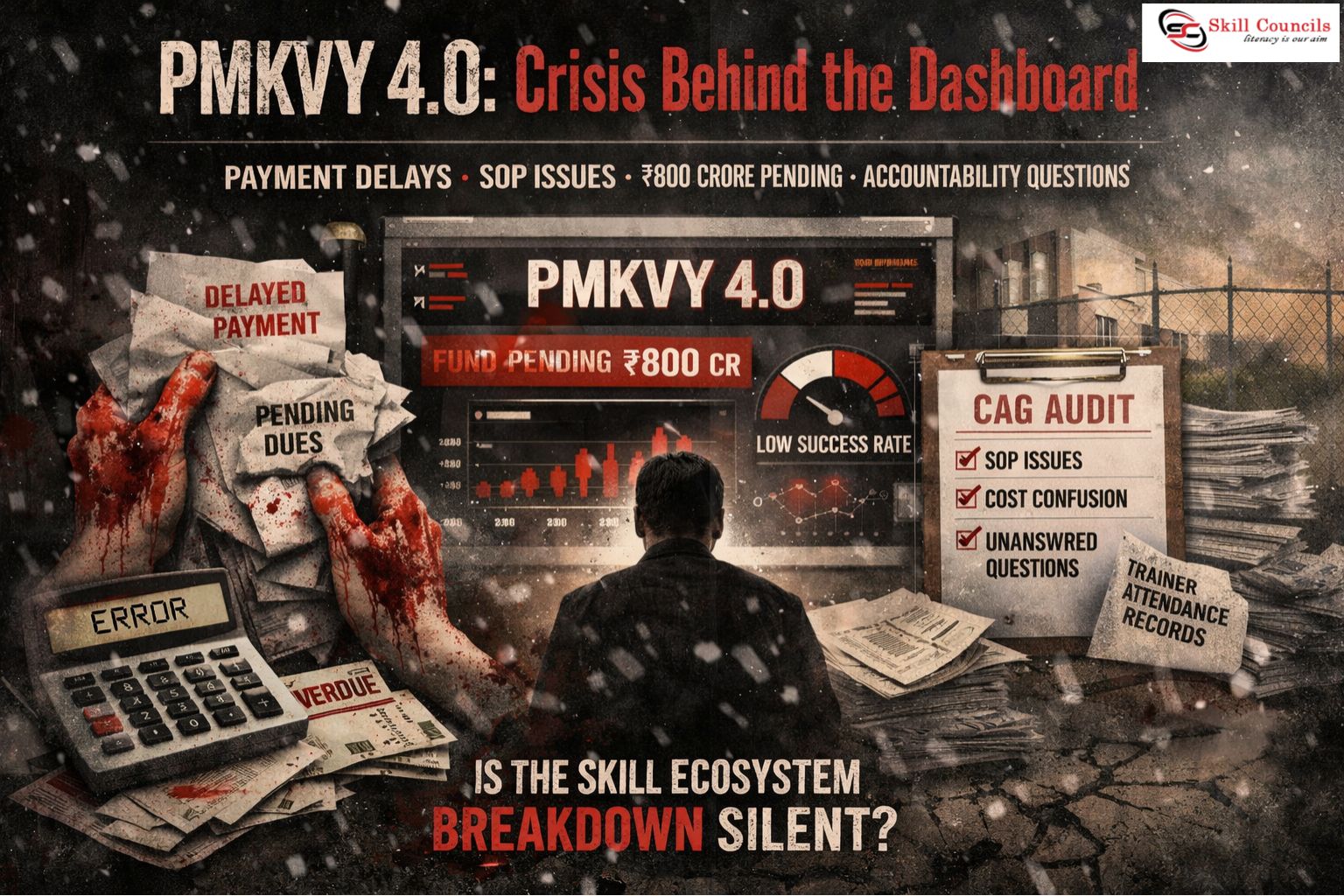
PMKVY Under the Scanner: CAG Audit Reveals Deep Structural Failures in India’s Flagship Skill Development Scheme
PMKVY Under the Scanner: When India’s Flagship Skill Scheme Failed Its Own Promise
₹14,000+ crore spent. Over a decade of implementation. Yet the core question remains unanswered: did Pradhan Mantri Kaushal Vikas Yojana (PMKVY) skill India for jobs—or merely generate certificates?
The Comptroller and Auditor General (CAG) of India’s Performance Audit Report No. 20 of 2025 presents a deeply troubling picture of India’s largest skill development programme. What emerges is not a story of transformation, but one of weak planning, poor oversight, unreliable data, questionable certifications, low placements, and systemic governance failures
1. No Long-Term Vision, No National Skill Plan
Despite PMKVY being launched in 2015 as a “continuing scheme”, the audit confirms that no long-term strategy or National Skill Development Plan (NSDP) was prepared for the first three phases (2015–2022)
Training targets changed phase-to-phase
- Guidelines were repeatedly revised
- Implementation lacked continuity and direction
Question:
How can a national skilling mission function for seven years without a roadmap aligned to India’s actual labour market needs?
How can a national skilling mission function for seven years without a roadmap aligned to India’s actual labour market needs?
2. Training Completely Misaligned with Skill-Gap Reality
The National Policy for Skill Development and Entrepreneurship (NPSDE) projected a requirement of 40.29 crore skilled workers by 2022. PMKVY targeted only 1.32 crore—and even that limited effort was poorly aligned with actual demand
Shocking sectoral distortions:
- Over 40% of training concentrated in Retail, Electronics, and Apparel
- These sectors accounted for less than 10% of projected demand
- High-demand sectors like Construction, Logistics, Tourism were under-served
State-level mismatch:
- States with higher projected demand received fewer trainings
- States with lower demand absorbed disproportionately higher targets
Question:
Was PMKVY driven by labour market demand—or by training provider convenience?
Was PMKVY driven by labour market demand—or by training provider convenience?
3. Job-Role Monopolies and Assembly-Line Skilling
The audit reveals a disturbing concentration of certifications:
- 40% of all certifications clustered in just 10 job roles
- Entire sectors reduced to single repetitive job roles
- Green Jobs → Safai Karmchari (90% of sector output)
- Healthcare → General Duty Assistant
- IT → Domestic Data Entry Operator
This is not workforce diversification—it is mass production of low-mobility skills.
Question:
Is PMKVY creating employable professionals—or trapping youth in narrow, low-wage roles?
Is PMKVY creating employable professionals—or trapping youth in narrow, low-wage roles?
4. Eligibility Norms Ignored, Targeting Failed
CAG found that candidates were enrolled without verifying:
- Age criteria
- Educational qualification
- Work experience
- Unemployment or dropout status
There was no mechanism to ensure that PMKVY actually targeted its intended beneficiaries.
Question:
If eligibility checks were ignored, how credible are PMKVY’s beneficiary numbers?
If eligibility checks were ignored, how credible are PMKVY’s beneficiary numbers?
5. Placement Claims Collapse Under Scrutiny
Out of 56.14 lakh candidates trained under Short-Term Training and Special Projects:
- Only 41% were placed
- In some states (notably Kerala), fake or incorrect placement documents were submitted by training partners
There was no reliable post-placement tracking system for most of the scheme period.
Question:
Can a skill scheme be called “successful” when nearly 6 out of 10 candidates remain unplaced?
Can a skill scheme be called “successful” when nearly 6 out of 10 candidates remain unplaced?
6. RPL-BICE: The Most Alarming Irregularities
Recognition of Prior Learning with Best-in-Class Employers (RPL-BICE) emerges as one of the most compromised components:
- Questionable selection of employers
- No employer–employee relationship in many cases
- Weak scrutiny of proposals
- Unreliable monitoring records produced by NSDC and implementing agencies
Question:
Was RPL-BICE about recognising skills—or inflating certification numbers at scale?
Was RPL-BICE about recognising skills—or inflating certification numbers at scale?
7. Financial Mismanagement and Weak Controls
Despite ₹10,194 crore being released:
- Funds were delayed or underutilised, especially at State level
- ₹222.63 crore remained idle due to poor fund planning
- NSDC retained ₹12.16 crore interest improperly, recovered only after audit
- ₹24.13 crore excess administrative charges were levied in PMKVY 1.0
Question:
Who was monitoring financial propriety when public money was parked, delayed, or overcharged?
Who was monitoring financial propriety when public money was parked, delayed, or overcharged?
8. IT Systems Without Data Integrity
For a scheme fully dependent on digital platforms:
- No data retention policy existed
- Training photos/videos, candidate records, and verification documents were not preserved
- Aadhaar-enabled biometric attendance was non-functional in many centres
Question:
How can outcomes be audited when digital evidence itself is missing?
How can outcomes be audited when digital evidence itself is missing?
9. Regulatory Vacuum and Weak Oversight
NCVET—the apex regulator—became operational only after most of PMKVY had already run. As a result:
- Qualification Packs lacked timely regulation
- Assessment and awarding bodies operated with minimal supervision
- Quality assurance remained largely theoretical
Meanwhile, the PMKVY Steering Committee met only 15 times in eight years.
Question:
Was PMKVY ever meaningfully governed—or merely administered?
Was PMKVY ever meaningfully governed—or merely administered?
Final Question: What Did PMKVY Actually Achieve?
The CAG does not allege fraud in isolation—it highlights systemic design failure.
PMKVY became:
- Input-focused, not outcome-driven
- Certificate-heavy, not employment-led
- Provider-driven, not demand-aligned
Unless these findings lead to accountability, course correction, and transparent reform, PMKVY risks becoming a cautionary tale of how large-scale public skilling can miss both market needs and youth aspirations.
Skill development cannot succeed on paper credentials alone. Jobs—not numbers—must be the real metric.
Source: Comptroller and Auditor General of India, Performance Audit Report No. 20 of 2025 on PMKVY

Recent Blogs
 in India Structure, Role, and Opportunities for Stakeholders.jpg)

.jpg)
.jpg)