

News Details
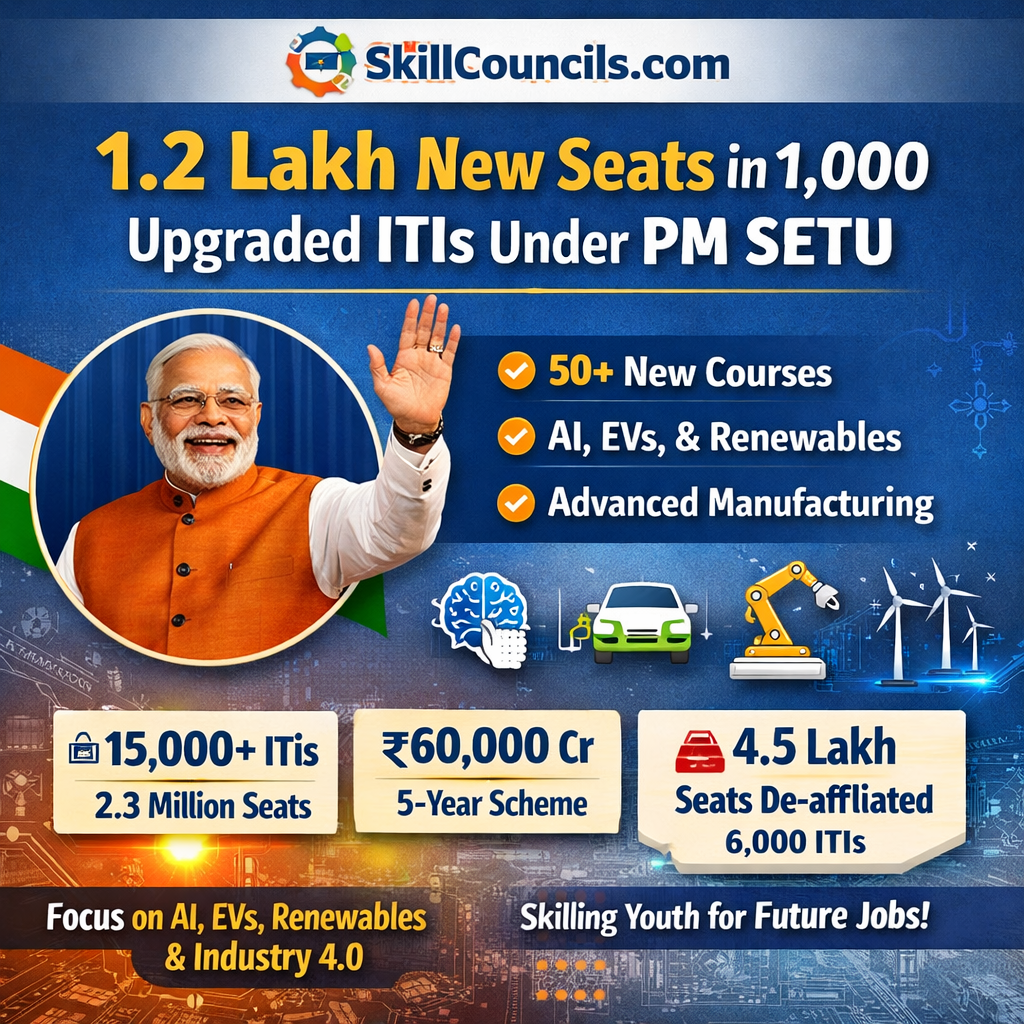
1.2 Lakh New Seats Planned in 1,000 Upgraded ITIs Under PM SETU
The Government of India has announced an ambitious plan to add 1.2 lakh new seats across 1,000 upgraded Industrial Training Institutes (ITIs) under the PM SETU initiative, aimed at enhancing the vocational education ecosystem.
This initiative will introduce over 50 new-age courses, focusing on high-growth and technology-driven sectors, including:
- - Artificial Intelligence (AI)
- - Solar & Renewable Energy
- - Semiconductors
- - Electric Vehicles (EVs)
- - Advanced Manufacturing
- - Automation & Industry 4.0
The expanded capacity is designed to equip youth with job-ready skills, aligning vocational training with industry needs. An official stated, “This additional capacity is expected to equip youth with job-ready skills and expand the scale of skill training in emerging sectors.”
Currently, India has approximately 15,000 ITIs with around 2.3 million seats. However, many institutes face challenges such as outdated course offerings, instructor shortages, and infrastructure gaps. In response, the Directorate General of Training (DGT) has de-affiliated nearly 4.5 lakh seats across 6,000 ITIs, emphasizing quality-driven reforms.
Governance frameworks are being strengthened, with ITI clusters identified across 32 States and Union Territories, and steering committees established in 26 states/UTs. Some states have already begun the rollout of these initiatives.
The PM SETU scheme, announced in the Union Budget 2024–25, has a total outlay of ₹60,000 crore over five years, with an allocation of ₹3,000 crore for FY26 and an expenditure of ₹356 crore so far. Overall funding has reportedly doubled to ₹6,141 crore.
This reform is significant for various stakeholders:
- **Students** will gain access to modern, employability-focused courses.
- **Industry** will benefit from a skilled workforce in emerging sectors.
- **Training Providers & Consultants** will find new opportunities for curriculum alignment and sector partnerships.
This strategic pivot towards technology-integrated
View News Document
Recent Blogs


.jpg)
.jpg)





 (4).png)
