

Blog Details
Is India’s Skill Development Strategy Misaligned with Employment Reality?
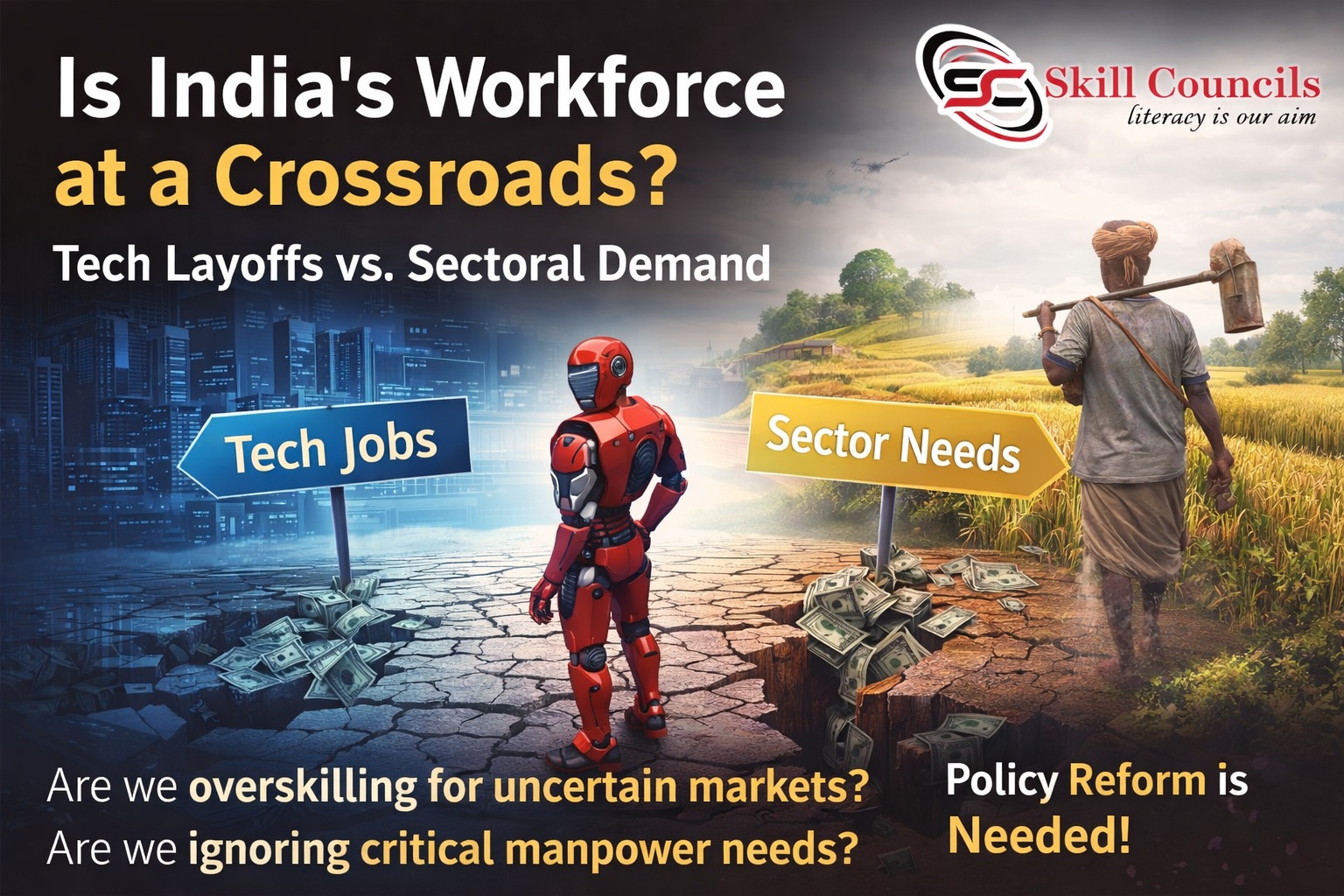
India stands at a defining moment in its workforce evolution. On one side, there is an aggressive push toward future technologies—Artificial Intelligence (AI), Machine Learning (ML), Robotics, AR/VR. On the other, there is a growing wave of layoffs, job insecurity, and a silent crisis in traditional sectors struggling to find manpower.
This raises a fundamental question:
Are we building a workforce for India’s real economy—or for a projected future that may not absorb them?
Are we building a workforce for India’s real economy—or for a projected future that may not absorb them?
The AI Paradox: Innovation vs. Dependency
India is rapidly adopting AI across sectors. Government initiatives, Skill India programs, and private training ecosystems are heavily focused on building capabilities in AI, ML, and emerging technologies.
But the critical question remains:
Is AI truly becoming a revenue engine for India—or are we largely consumers of global AI innovation?
Is AI truly becoming a revenue engine for India—or are we largely consumers of global AI innovation?
Most foundational AI technologies, platforms, and infrastructure are controlled by global tech giants. Indian companies and professionals often operate as:
- Service providers
- Implementation partners
- End-users of AI platforms
This creates a value imbalance, where:
- India supplies talent
- But revenue concentration remains with global innovators
Without strong domestic product ecosystems, skilling alone cannot translate into economic leadership.
The Reality Check: Rising Tech Layoffs
While we are training millions for high-tech roles, the job market is sending a different signal.
Recent developments highlight this contradiction:
- Oracle reportedly laid off 10,000+ employees in India
- ~30,000 tech jobs cut globally within the first 40 days of 2026 (Amazon, Salesforce, and others)
- TCS laid off 12,000 employees, raising concerns about IT services stability
- Startups like Zupee and Porter continue workforce reductions
This is not a temporary correction—it reflects structural changes:
- Automation replacing mid-level roles
- AI increasing productivity but reducing workforce demand
- Shift from mass hiring to lean, specialized teams
The era of “guaranteed IT jobs” is clearly over.
The Silent Crisis: Labour Shortage in Core Sectors
While tech layoffs dominate headlines, another crisis is unfolding quietly:
Severe manpower shortages in sectors like:
- Textiles & Apparel
- Food Processing
- Logistics & Supply Chain
- Agriculture (including Hydroponics)
- Manufacturing & MSMEs
These sectors are actively hiring, yet struggling to find workers.
Why?
Key Challenges:
- Wage vs Cost of Living Mismatch
Workers are unwilling to migrate interstate because salaries do not justify living expenses. - Low Aspirational Value
Youth prefer white-collar or tech roles—even if uncertain—over stable blue-collar opportunities. - Lack of Mobility Incentives
There are limited policy mechanisms supporting relocation, housing, or social security portability. - Skill Misalignment
Training programs are not aligned with real-time local demand.
The Core Problem: Supply-Driven Skilling
India’s skill development ecosystem is largely supply-driven, not demand-driven.
We are:
- Training based on trends
- Not based on actual absorption capacity
This leads to:
- Oversupply in high-tech domains
- Undersupply in essential sectors
Result:
A growing pool of “trained but unemployed” youth, alongside industries facing labour shortages.
A growing pool of “trained but unemployed” youth, alongside industries facing labour shortages.
igration Gap: India’s Structural Weakness
One of the biggest bottlenecks is low interstate workforce mobility.
Unlike countries with high labour mobility, India faces:
- Cultural barriers
- Language challenges
- Lack of affordable housing
- Weak social protection systems
Unless migration becomes economically viable,
regional skill shortages will continue despite national-level unemployment.
regional skill shortages will continue despite national-level unemployment.
What Needs to Change: Policy-Level Reforms
India does not need more training programs—it needs smarter, aligned, and outcome-driven skilling policies.
1. Demand-Linked Skilling
- Align training programs with district-level industry demand
- Real-time labour market intelligence systems
2. Strengthening Domestic Innovation
- Incentivize Indian AI product companies
- Move from service economy → product economy
3. Migration Support Policies
- Rental housing schemes for workers
- Interstate worker mobility incentives
- Portable benefits (ESI, PF, insurance)
4. Wage Rationalization
- Align wages with regional cost of living
- Introduce productivity-linked incentives
5. Sectoral Rebalancing
- Elevate traditional sectors through:
- Technology integration
- Better branding
- Career progression pathways
6. Industry Accountability
- Mandatory placement-linked training models
- Outcome-based funding for skilling programs
The Way Forward: A Balanced Workforce Strategy
India’s growth story cannot rely solely on AI and high-tech sectors. Nor can it ignore them.
The real solution lies in balance:
- High-tech innovation + strong traditional sectors
- Future skills + present demand
- Training + employment linkage
Because ultimately:
A nation is not skilled when its people are trained.
A nation is skilled when its people are employed productively.
A nation is skilled when its people are employed productively.
Conclusion
India’s workforce strategy is at a crossroads.
If we continue to chase aspirational skills without aligning them to economic realities, we risk creating a generation that is:
- Educated
- Certified
- But unemployed
The time has come to shift from “Skill Development” to “Employment-Centric Workforce Planning.”
#SkillIndia #AI #MachineLearning #FutureOfWork #Employment #TechLayoffs #IndiaEconomy #WorkforceDevelopment #PolicyReform #VocationalTraining #MSME #Agriculture #Logistics #Manufacturing #DigitalIndia #StartupEcosystem #JobMarket #EconomicPolicy #SkillGap #LabourMarket

Recent Blogs
 in India Structure, Role, and Opportunities for Stakeholders.jpg)

.jpg)
.jpg)