
Blog Details
PMKVY 4.0 Crisis: Payment Delays, SOP Confusion & Accountability Questions
PMKVY 4.0: Between Policy, Pressure, and Pending Truths – Who Will Answer?
The truth today is unsettling.
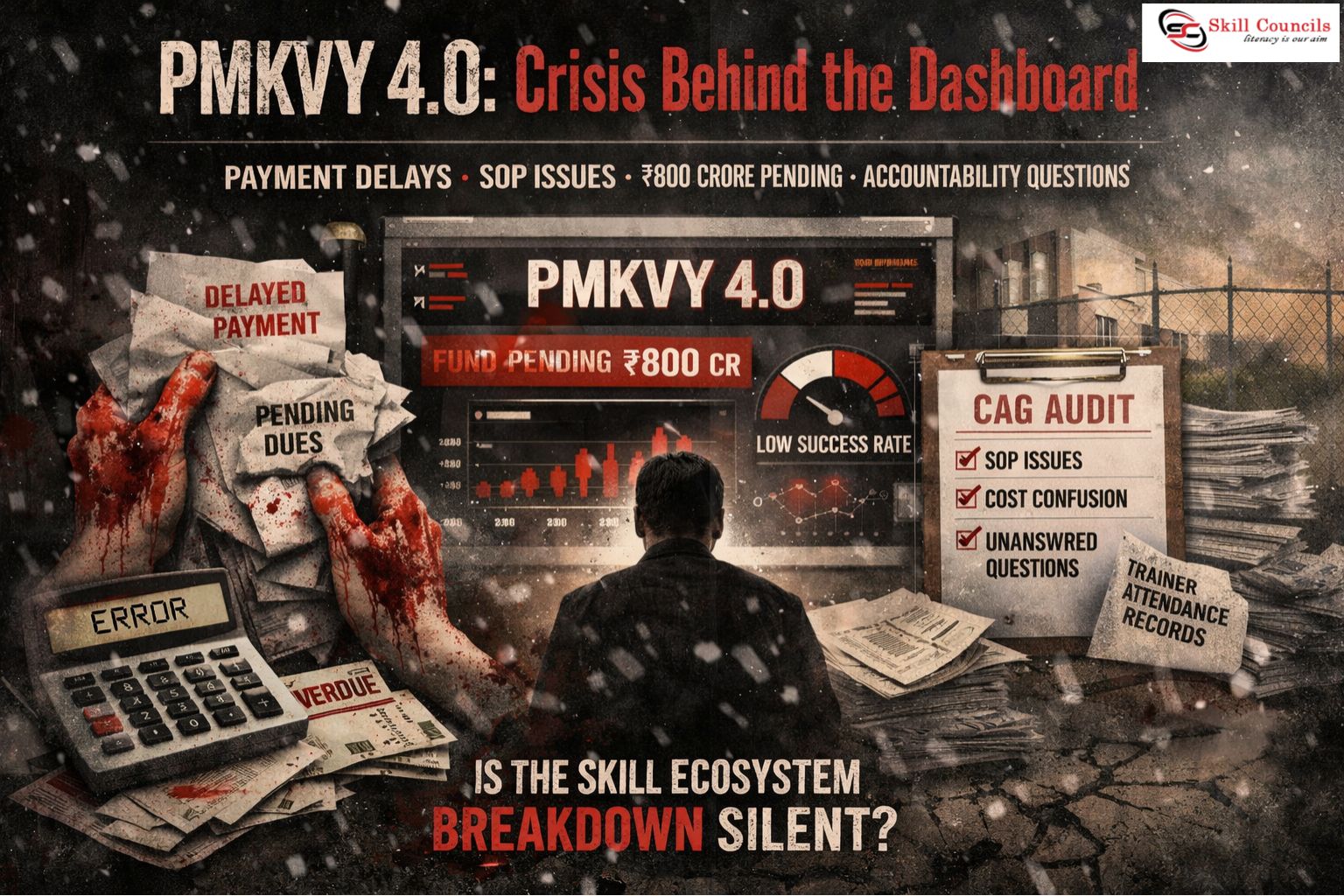
It feels like white blood spilled on black paper ink—a system that appears clean on documentation but is deeply strained beneath the surface. Standard Operating Procedures (SOPs) seem to fall like silent snow—visible, structured, but often cold, disconnected, and ineffective on ground reality.
Training centers across India are not just struggling—they are bleeding. The “soil” of the skill ecosystem is marked with operational stress, delayed payments, compliance overload, and growing uncertainty.
Dashboards may show progress in red and black metrics, but behind those numbers lies a fragmented narrative—one where memes replace accountability, and mathematics of performance is manipulated through selective justification for public relations (PR).
And yet, the ecosystem waits—perhaps for a NavYug (new era)—a reset.
The Unanswered Questions in PMKVY 4.0
The skill development ecosystem, especially stakeholders under Pradhan Mantri Kaushal Vikas Yojana 4.0, is grappling with critical questions that demand clarity and accountability.
1. Who is Accountable? Who is Writing the Ground Reality?
There is a growing disconnect between:
- Policy-level narratives
- Ground-level execution
Who is documenting the real struggles of Training Partners?
Who is accountable for operational failures?
Who is accountable for operational failures?
Is the system relying more on reports than reality?
2. Has NSDC Failed in PMKVY 4.0 Operations?
The role of National Skill Development Corporation has always been central to execution, monitoring, and fund disbursement.
However, concerns emerging from stakeholders suggest:
- Delays in payment cycles
- Inefficiencies in batch monitoring
- Lack of real-time grievance redressal
- Repetition of issues seen during earlier PMKVY phases
This raises a serious question:
Is PMKVY 4.0 repeating the operational gaps of PMKVY 1.0, despite years of learning?
Is PMKVY 4.0 repeating the operational gaps of PMKVY 1.0, despite years of learning?
3. Are SOPs Reliable or Just Formalities?
Standard Operating Procedures (SOPs) are meant to ensure clarity and consistency. However:
- Frequent changes
- Lack of practical alignment
- Complex compliance layers
...have made SOPs difficult to implement on ground.
Training Partners now question:
Are SOPs guiding execution—or simply documenting expectations?
There is an urgent need to:
- Simplify SOP frameworks
- Align them with real training environments
- Ensure stability in guidelines
4. What About the Revised Common Cost Norms?
The ambiguity around Common Cost Norms is creating confusion:
- Will the updated norms apply from 1st April 2026?
- Or will they impact ongoing and under-evaluation projects?
This lack of clarity affects:
- Financial planning
- Proposal structuring
- Sustainability of training centers
A clear directive from authorities is critical to avoid financial disruption.
5. ₹800 Crore Pending – Is ₹76 Crore Approved Enough?
Reports suggest that the Ministry of Skill Development and Entrepreneurship has approved approximately ₹76 crore for disbursement out of nearly ₹800 crore pending dues.
If true, this raises serious concerns:
- Why is such a large amount still pending?
- What is the timeline for full disbursement?
- How are Training Partners expected to sustain operations in the meantime?
Delayed payments are not just financial issues—they directly impact:
- Trainer salaries
- Infrastructure maintenance
- Student trust
6. Is the System Preparing for the Next CAG Report?
There are indications that authorities are now collecting original hard copies of trainer attendance records.
This move raises speculation:
- Is it a compliance tightening measure?
- Or preparation for scrutiny by the Comptroller and Auditor General of India?
If so, it reflects a reactive approach rather than a proactive system of transparency and digital governance.
Ground Reality vs Dashboard Reality
While dashboards show:
- Enrollment numbers
- Certification rates
- Placement statistics
The ground reality reflects:
- Struggling training centers
- Overburdened compliance systems
- Financial instability
This duality creates a dangerous illusion of success.
The Way Forward: From PR to Policy Reform
To rebuild trust and efficiency in PMKVY 4.0, the following steps are critical:
1. Transparent Payment Mechanism
- Time-bound disbursement cycles
- Public dashboards for fund tracking
2. SOP Rationalization
- Simplification of guidelines
- Field-tested frameworks
3. Policy Stability
- Reduce frequent changes
- Provide long-term clarity
4. Real-Time Grievance Redressal
- Dedicated escalation systems
- Accountability tracking
5. Data Integrity Over Documentation Pressure
- Shift to digital-first compliance
- Reduce dependency on physical records
Waiting for NavYug or Building It?
The ecosystem cannot afford to wait endlessly for a “NavYug.”
The transformation must begin now—with:
- Honest acknowledgment of gaps
- Institutional accountability
- Ground-driven policy reform
The questions raised are not accusations—they are reflections of a system under stress.
And unless answered with clarity and action,
the red-black dashboards will continue to hide a deeper truth written in white—visible, but ignored.
the red-black dashboards will continue to hide a deeper truth written in white—visible, but ignored.

Recent Blogs
 in India Structure, Role, and Opportunities for Stakeholders.jpg)

.jpg)
.jpg)