

Blog Details
MSDE Notifies Common Norms Sixth Amendment 2026: Major Increase in Skill Training Costs and 10% Incentive for Special Areas
MSDE Notifies Common Norms Sixth Amendment 2026: Higher Training Costs and Special Area Incentives Strengthen India’s Skill Ecosystem
Introduction
India’s skill development ecosystem has received a major policy boost with the notification of the Common Norms for Skill Development Schemes Sixth Amendment, 2026 by the Ministry of Skill Development and Entrepreneurship (MSDE).
Published in the Gazette of India on February 26, 2026, the amendment introduces revised base training costs for skill development programmes and additional incentives for Special Areas, marking one of the most significant updates to the financial framework governing government-supported skill initiatives in recent years.
CCN 2026 Skill Developments…
The reform aims to address rising operational costs, improve training quality, and ensure stronger implementation of vocational education and skill development schemes across India.
For training providers, skill missions, project implementing agencies, and policymakers, the Sixth Amendment represents an important shift in funding structures that will influence future skill development projects and tenders.
Background: Evolution of Common Norms for Skill Development
The Common Norms for Skill Development Schemes were first notified on July 15, 2015 to standardize financial assistance, training duration, assessment processes, and quality benchmarks across government-funded skill programmes.
Since then, the framework has been revised multiple times to keep pace with the evolving needs of India’s skill ecosystem. Previous amendments were issued in:
- May 2016
- February 2017
- December 2018
- November 2020
- January 2021
The Sixth Amendment 2026 builds upon these reforms by introducing updated training cost norms and targeted support for geographically challenging regions.
CCN 2026 Skill Developments_Ski…
Key Highlights of the Sixth Amendment 2026
1. Significant Increase in Base Training Costs
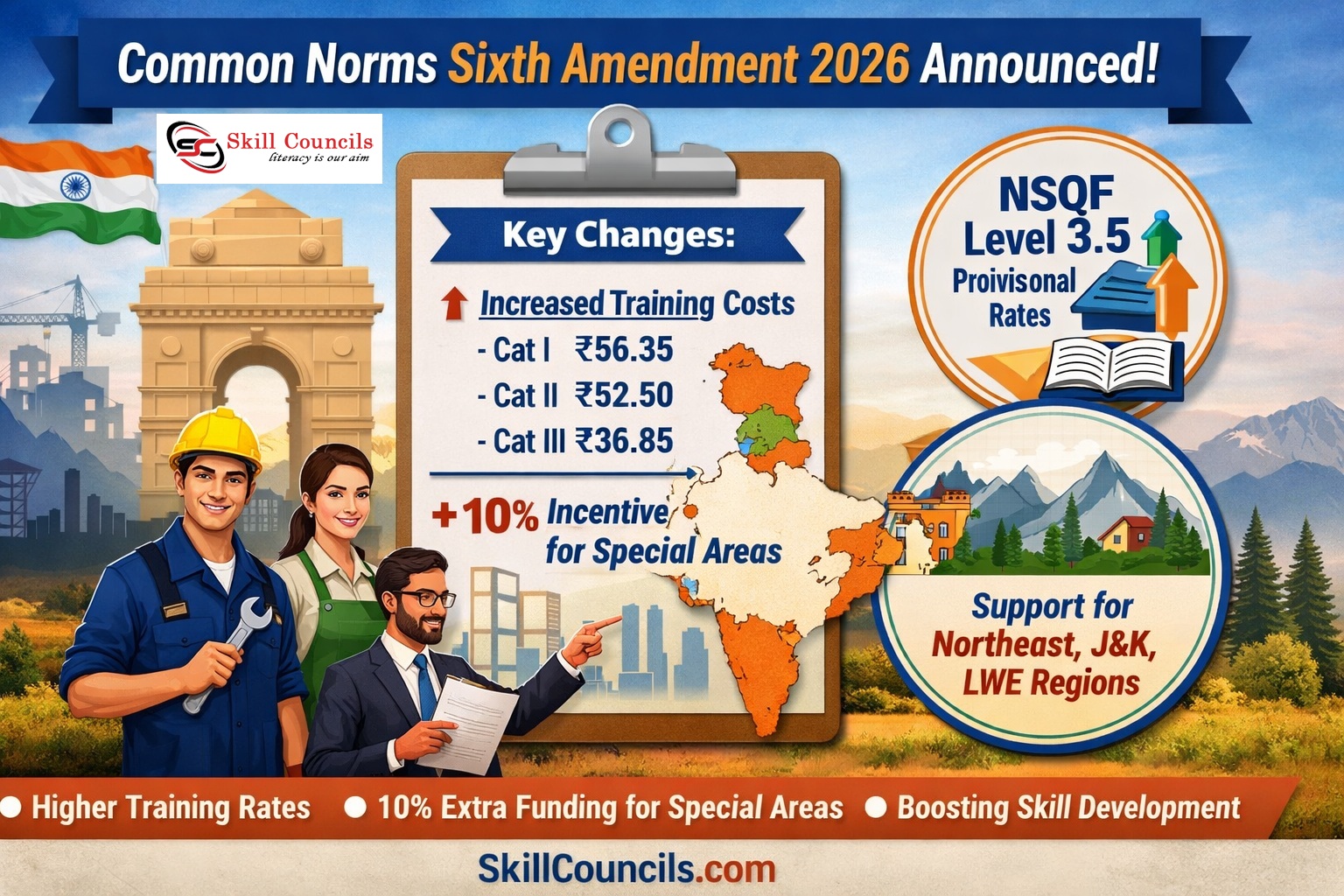
One of the most important changes introduced in the amendment is the increase in base training costs across three sector categories.
The revised per-hour training costs are as follows:
|
Category
|
Increase
|
Revised Base Cost (Per Hour)
|
|
Category I
|
15%
|
₹56.35
|
|
Category II
|
25%
|
₹52.50
|
|
Category III
|
5%
|
₹36.85
|
These revised costs apply to job roles listed under Schedule-II of Annexure-I and come into effect immediately from the date of notification.
CCN 2026 Skill Developments_Ski…
Why the Cost Revision Matters
The increase in base training costs addresses several structural challenges in the skill training ecosystem, including:
- Rising operational and compliance costs
- Increased trainer remuneration requirements
- Higher infrastructure and equipment investments
- Growing demand for industry-relevant training standards
By rationalizing training costs, the government aims to ensure financial sustainability for training providers while maintaining high quality training outcomes.
2. Provisional Applicability up to NSQF Level 3.5
The amendment introduces new provisions clarifying the applicability of the revised training costs.
The updated cost norms will:
- Apply provisionally across all sectors.
- Be applicable specifically to job roles up to NSQF Level 3.5 after re-categorization.
- Remain in force until a separate methodology is finalized for job roles above NSQF Level 3.5.
CCN 2026 Skill Developments_Ski…
The National Skill Development Corporation (NSDC) ecosystem and various implementing agencies will continue using these interim rates for training programmes aligned with the National Skills Qualifications Framework (NSQF).
This provision provides clarity for ongoing projects while allowing the government time to design a more refined cost structure for higher-level job roles.
3. 10% Additional Funding for Special Areas
To promote inclusive skill development across geographically challenging regions, the amendment allows an additional 10% cost over and above the base training cost for programmes conducted in designated Special Areas.
These areas include:
- North Eastern States
- Jammu & Kashmir
- Ladakh
- Himachal Pradesh
- Uttarakhand
- Andaman & Nicobar Islands
- Lakshadweep
- Districts affected by Left Wing Extremism (LWE) identified by the Ministry of Home Affairs.
CCN 2026 Skill Developments_Ski…
Purpose of Special Area Incentives
Skill training programmes in these regions often face unique challenges such as:
- Difficult terrain and transportation constraints
- Limited training infrastructure
- Higher operational costs
- Socio-economic vulnerabilities
The additional funding support is expected to encourage greater participation from training providers and expand skill development initiatives in underserved regions.
Impact of the Amendment on the Skill Development Ecosystem
The Sixth Amendment will have far-reaching implications across the entire skill ecosystem.
1. Impact on Training Providers (TPs)
Training providers will benefit through:
- Improved financial sustainability
- Better trainer compensation structures
- Ability to upgrade infrastructure and equipment
- Greater viability for long-term skill projects
The revised norms also encourage providers to maintain higher training quality standards and adopt industry-aligned curriculum delivery models.
2. Impact on State Skill Development Missions
State skill missions will gain stronger implementation capabilities through:
- Enhanced funding structures
- Better programme viability in remote regions
- Increased participation from training partners
- Improved training infrastructure in aspirational districts
This is expected to strengthen the implementation of national programmes like:
- Pradhan Mantri Kaushal Vikas Yojana
- Skill India Mission
3. Impact on Learners and Job Seekers
Ultimately, the most important beneficiaries are students and trainees.
The revised funding norms will help deliver:
- Higher quality training facilities
- Better trained instructors
- Modern equipment and learning resources
- Improved employability outcomes
This aligns with India’s long-term objective of building a globally competitive skilled workforce.
Strategic Implications for Skill Development Projects
The Sixth Amendment will also influence how future skill development tenders, projects, and training programmes are designed.
Key strategic changes include:
1. Revision of Training Budgets
Training providers must revise project budgets to incorporate the new base cost structure.
2. Updating Project Proposals and DPRs
Detailed Project Reports (DPRs) and technical proposals for skill development projects will need to reflect the updated financial norms.
3. Financial Planning for Implementing Agencies
Skill implementing agencies must update:
- Cost models
- Training projections
- Funding requirements
4. Increased Viability for Special Area Projects
Projects in Northeast, Himalayan regions, and LWE-affected districts will now become financially more viable.
Policy Significance: Strengthening India’s Skill Economy
The Sixth Amendment reflects the government’s continued commitment to strengthening India’s vocational education and skill development framework.
By addressing cost pressures and ensuring adequate financial support for training programmes, the amendment aims to:
- Maintain training quality standards
- Encourage wider participation from training providers
- Expand skill access in remote and underserved regions
- Support the long-term vision of a skilled and employable workforce
With India aspiring to become a global talent hub, reforms like these are essential to maintain the scalability, sustainability, and effectiveness of national skill programmes.
Conclusion
The Common Norms Sixth Amendment 2026 represents a critical milestone in the evolution of India’s skill development policy framework.
By revising base training costs and introducing additional support for Special Areas, the government has taken a decisive step toward:
- Strengthening training infrastructure
- Improving programme quality
- Expanding skill access in remote regions
- Supporting sustainable implementation of skill development initiatives
For training providers, State Skill Development Missions, implementing agencies, and policymakers, aligning with the revised norms will be essential for future skill projects and funding opportunities.
As India continues to build a robust, inclusive, and globally competitive skill ecosystem, these reforms will play a vital role in shaping the future of vocational education and workforce development.
✅ For the latest updates on skill policies, tenders, government schemes, and industry insights, stay connected with SkillCouncils.com.

Recent Blogs
 in India Structure, Role, and Opportunities for Stakeholders.jpg)


.jpg)
.jpg)